

There’s nothing quite like having to ask three times in one conversation what something means to make you feel old. Sitting with my daughter at dinner in Mexico required its own dictionary.
When she said “chopped,” she wasn’t referring to anything on the menu or a special salad, which I found myself looking for.
For those of you who don’t speak Gen Z, let me save you the trouble of looking it up. Apparently, “chopped” means not looking your best.
You’re welcome.
I’ve spent the last several days with her. Experiencing life through her lens has been such a gift. She’s 21. I’m 52. While we’ve shared so many of the same experiences, we didn’t experience them in the same way. We still don’t. We each have our own window into the world.
Admittedly, hers comes with a vernacular I’m still learning. Decoding Gen Z requires a whole different kind of blueprint and subscriptions to a few apps I’m unwilling to download.
And maybe that’s exactly where we each get stuck. In the unwillingness.
I don’t mean the anti-TikTok kind of unwillingness, but the unwillingness to cast a wider net. To consider that our understanding of something might not be the only one. That someone else’s experience might be entirely different from our own, even when we’ve lived through the very same thing.
And being willing to listen doesn’t require us to agree.
I don’t need to download TikTok to understand her relationship with trends and generational social norms. I simply have to listen with an open mind and a sense of curiosity.
I can hold firm to my own values, opinions, and boundaries while remaining curious about how someone else experiences the world.
Which makes this the perfect week to begin with the first pillar in our new series, What If We Choose Joy?, inspired by The Book of Joy, a conversation between the Dalai Lama and Archbishop Desmond Tutu.
The first half of the book explores the obstacles to joy. Fear, anger, anxiety, stress, envy, loneliness. Let’s not forget rumination either. My analytical brain loves to spin, turn, twist, and sit in my own story of anguish far longer than I care to admit.
The second half offers the Eight Pillars of Joy, four qualities of the mind and four of the heart that we can cultivate to experience more joy. Not just in anticipation of the holidays, but as part of our everyday lives.
The first of the Eight Pillars of Joy is Perspective.
Perhaps there’s a reason it comes first. Sometimes the greatest obstacle to experiencing joy isn’t what’s happening around us. It’s how we’re seeing it.
I’ve read The Book of Joy countless times. I’ve shared these principles in yoga classes, explored them in workshops, and returned to them again and again. And yet, here I am, on the very first pillar, and I’m not quite ready to turn the page.
Which brings me back to Mexico.
While I was digitally detoxing with The Book of Joy, she was furiously texting her boyfriend about their Halloween plans, her fingers ripping across her phone faster than the eye could follow. Another Gen Z skill that leaves me in awe.
When I asked what the plans were, she lit up. They were going to carve pumpkins.
I reminded her that she hates carving pumpkins. “You love carved pumpkins,” I said. “You don’t love carving them.”
“Mom, I loved doing that.”
“You loved it when I did it. Not when you did it.”
And I had proof. An epic photo of her reaction, hand deep in the belly of a pumpkin.
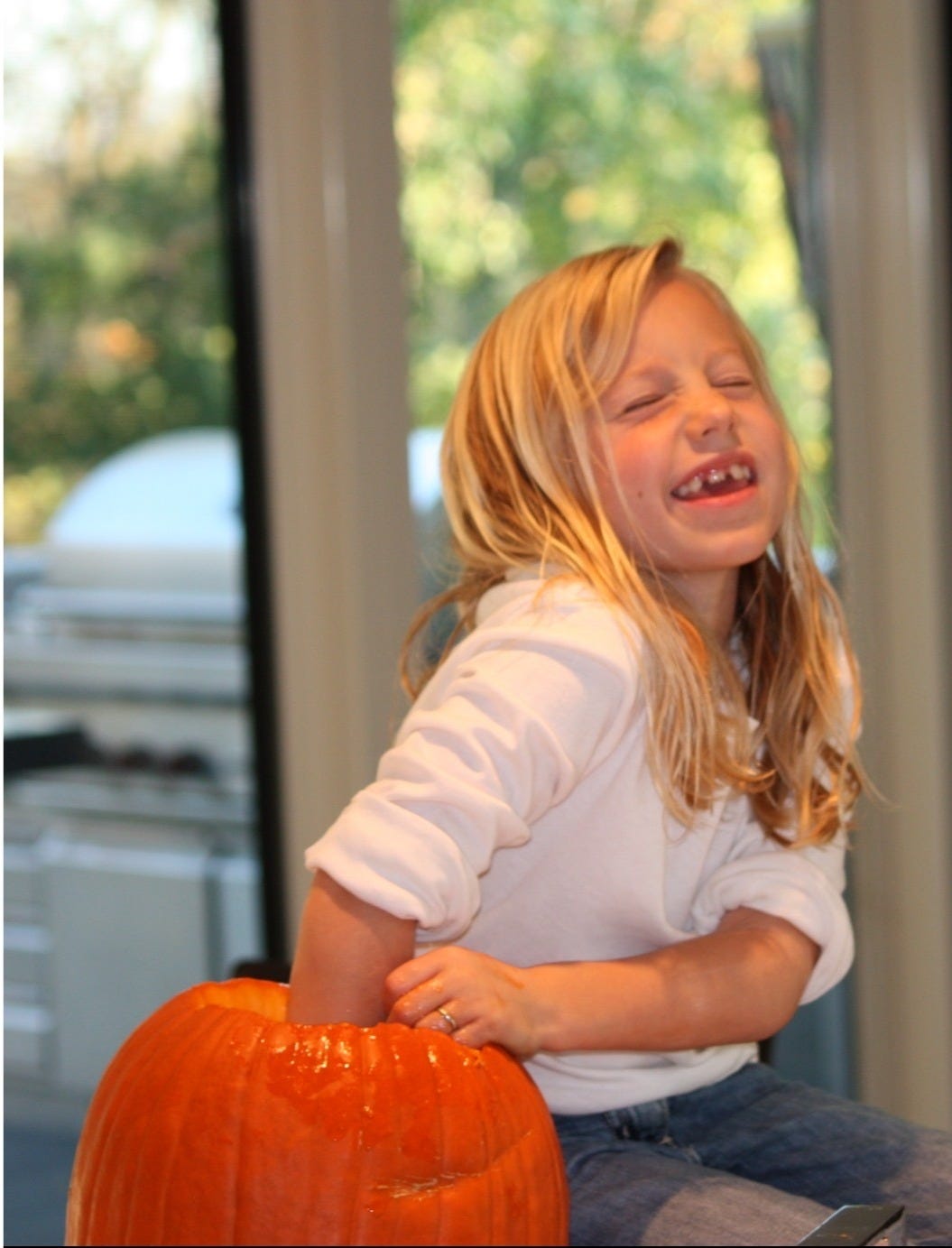
She was convinced she was right. I had photographic evidence to support my version.
But here’s what I hadn’t considered. She could have hated putting her hand inside that pumpkin and still loved the idea of carving it.
Maybe we were both right.
And maybe that’s what happens when we’re willing to consider another perspective. We might actually discover that our version of events isn’t necessarily the whole story.
What’s that age-old saying? There are two sides to every story. Although I suspect there are often quite a few more.
The pumpkin story is silly, of course. But it does lend itself to a much bigger question.
How tightly are we willing to hold on to our own version of events? Our opinions, our beliefs, our perspective of a person or situation?
And at what cost?
Because there’s something on the other side of our need to be right. Sometimes it’s a friendship. Sometimes it’s a relationship. Sometimes it’s our ability to connect with someone whose experience of the world is distinctly different from our own.
In The Book of Joy, the Dalai Lama talks about moving from me to we. And I can’t help but think about how much joy we potentially give up when we remain so firmly planted in the me.
We don’t have to agree with someone else’s perspective. But what happens if we listen? Again, we might not agree, but in the process, we may learn something. We might expand our awareness, make room for new possibilities, and even lessen some of the burdens we carry.
There is no question that much of my own suffering comes from living in my head, consumed by frustration, judgment, and worry.
It’s exactly why I return to this book again and again.
The Pillars of Joy are a practice. Shifting perspective is a practice.
This week, I’m inviting you to consider a question I’ve been asking myself.
What are you holding on to so tightly that it might be costing you joy?
I’m going to do the same. Next week, I’ll turn the page to Humility.
Until then, maybe I’ll even slay at speaking Gen Z while I’m vibing with my daughter. No cap.
With Intention,
Leslie
P.S. Speaking of perspective, I’ve had a rather startling realization about myself lately. Somewhere along the way, I stopped being FUN! Apparently, I’ve been spending far too much time in my head and not nearly enough in my heart.
I’m writing about this rather humbling discovery, and what I’m doing about it, in Thursday’s edition of The Preferred Edit. I suspect I’m not alone in this one.
Clearly, I would love your perspective. Drop a comment. I read them all!
Welcome to The Founder’s Letter, a weekly publication of The Preferred EDIT, where the practice of yoga meets the practice of living.


There is a video I watched not too long ago that reminds me a lot of a specific part of this article. The girl was saying, " Nothing bad happens to me," and for everyone it's like "yeah whatever," but if you open your mind and listen with curiosity, as you said, she had an amazing point. Nothing bad happens to her cause what if that thing is just a door opening for something way better, and in the future that "bad thing" will be the best thing in your life?