


There are two unopened letters sitting on my kitchen counter.
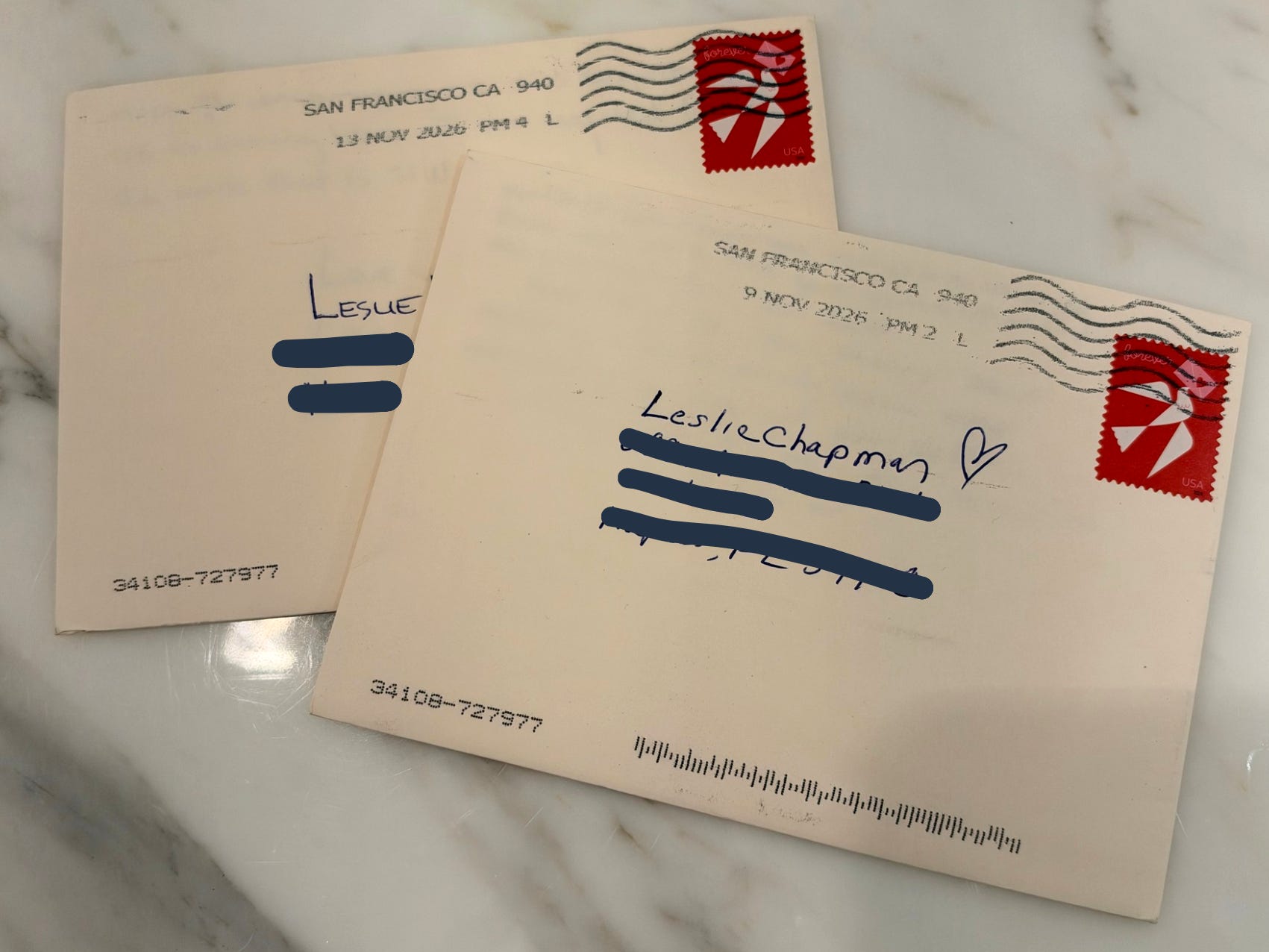
Both were written with love. I can’t bring myself to open either one.
An article on gratitude should be the easiest one to write in this entire series. Particularly as we approach Thanksgiving, when everywhere I turn, I’m reminded to give thanks.
After all, there’s an entire genre devoted to it on social media. Bookstores have sections dedicated to it. There are websites selling T-shirts with gratitude slogans, apps, journals, coffee table books, and accessories expressing every imaginable sentiment.
Gratitude isn’t just something we can practice daily. It’s something we can buy, display, and give away.
Ironically, I’m finding this one of the most challenging articles to write.
It’s not as though I’m not a grateful person. Quite the opposite.
I’m incredibly grateful for the beautiful life I get to live, for my family and friends, and for the community of people who have supported me, encouraged me, and brought so much joy into my world.
Expressing gratitude toward others comes easily to me.
Receiving it, however, is an entirely different story.
The other night, my husband and I attended a workshop on gratitude and joy. During our small group discussion, one of the participants shared a realization he’d recently come to.
He had grown up in an environment where appreciation and gratitude weren’t expressed. As a result, accepting those expressions from others as an adult felt deeply uncomfortable.
His words landed so viscerally in my body that I almost couldn’t believe what I was hearing.
He had just articulated something I had never been able to put into words myself.
I have a very difficult time accepting appreciation from others.
There. I said it.
I can write a heartfelt note, acknowledge someone’s contribution, celebrate another person’s success, or express my appreciation without giving it a second thought.
But when someone expresses those same sentiments toward me, I deflect.
If you’re a deflector too, I’m sure you know exactly what I mean.
I suspect there’s something deep-seated about this that I need to spend some time exploring. I haven’t quite figured out where it comes from, or why it makes me so uncomfortable.
I don’t have those answers today.
But I do have those two letters that I know are worthy of reading.
One is a letter I wrote to myself about a month ago at the conclusion of a personal development program. We were asked to write ourselves a letter, which would be mailed to us at a later date.
I don’t even remember what I wrote.
But there it sits. Unopened.
The second arrived from someone who means more to me than I could ever adequately express.
I know the envelope contains words of appreciation and gratitude toward me.
And yet, for whatever reason, I can’t seem to bring myself to open that one either.
I realize how strange this must sound. Here I have two letters sitting on my kitchen counter, both written with love and appreciation, and I can’t bring myself to read either one.
This isn’t something new for me. I can pinpoint other moments in my life when I’ve felt this same resistance. It’s not just with letters. Compliments and expressions of love bring up the same discomfort.
At that workshop the other night, hearing someone else put words to something I’ve felt for so long, oddly enough, allowed me to exhale and look at this pillar of joy in an entirely different way.
What I’m beginning to realize is that if I’m going to fully embrace gratitude, I need to learn to accept it for myself as readily as I extend it to others.
Perhaps that’s part of the wisdom the Dalai Lama and Archbishop Desmond Tutu are inviting us to consider in this chapter of The Book of Joy.
To fully give, we must also be willing to fully receive.
For all the gratitude I feel toward the people in my life, I wonder how much joy I’ve been missing by being so uncomfortable accepting their appreciation in return.
So this week, I’m going to practice gratitude a little differently, with patience and humility.
I’m going to listen when someone offers a kind word. And when I say listen, I mean really listen. I realize that my default response often minimizes what’s being said when I immediately try to change the subject or feel the need to respond with something in return.
In hindsight, I can only imagine how that must feel for the person offering those kind words. For that, I owe a lifetime of apologies to countless people in my life.
I’m also going to open those two letters. Not in a rush, either. I’m going to sit down, read every word, and give myself the time to appreciate everything that was written.
Gratitude isn’t only something we’re meant to give. We need to learn how to receive it, too.
Happy Thanksgiving.
Always EDITing,
Leslie
Are you better at giving gratitude or receiving it? Please share! I may struggle to read those letters, but I love reading your comments.
P.S. If you’re just arriving here, welcome to this multi-part series on Joy. If you’d like to catch up, I invite you to explore the archive of articles in the Founder’s Letter corner of my Substack.



Receiving gratitude is something that can be practiced, followed by recognition of the positive feelings that arise. Grateful for your writing.
“To fully give, we must also be willing to fully receive.” So much yes. The act of receiving is very challenging for me. (That’s probably why I rarely ask for help.) I have a hunch that since you shared this, reading those letters may be a bit easier 🖤 Saying the thing out loud tends to soften the edges.