

A few months ago, I was accused of something.
A Law & Order type accusation.
The story itself isn’t worth retelling. It feels like drama. Not worthy of air space.
But in the moment, I was cast into a role. I wanted to defend myself.
I didn’t.
Then a friend called me this week. Spiraling. She’d been similarly accused, something she’d said, twisted by the time it landed.
Word-slide.
Like that age-old game of operator.
What got back wasn’t anything close to what she said.
She wanted to rush to the table to defend herself. To explain. To set the record straight.
She too had been cast into a role.
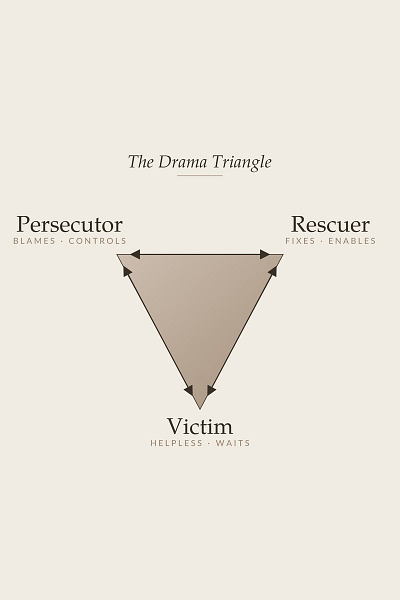
Persecutor.
Here’s the part nobody says out loud.
We don’t negotiate these roles with the people we’re in them with. We assign them. They are assigned to us. We rotate through them. Silently. In our own stories. In theirs.
Then we wonder why everyone seems miscast. Why we are so misunderstood. Why we are being talked about when we aren’t even in the room.
A few months earlier, I was rereading Daring Greatly. The section on parenting. On shame. On the quiet ways we pass it down without meaning to.
I didn’t ease into the realization. It hit all at once.
I have been quietly rescuing my daughter.
For years.
We often joke that the umbilical cord was never fully cut. The reality is, I never let go.

I have stepped in too quickly. Buffered her from consequences. Made things easier when they were supposed to be hard.
Every time I did that, I was telling her something underneath it: that she couldn’t handle it on her own. That the world was happening to her. That she needed me to make it right. Isn’t that what a parent is supposed to do… ease the pain?
In reality, I had cast her as the victim.
I had been trying to rescue her… for a lifetime. Hers.
The accusation I opened with is different.
The hardest one. Because it’s a role I never took. It was assigned.
A result of word-slide. Or more simply someone wanting to shift the narrative. To make me wrong. Make me the villain. It’s hard to know exactly. Ultimately, I was cast as the persecutor.
You can’t audition out of it. You can only choose not to perform.
There is another role in this world of drama. The one I almost sat in.
I was the first one to say I love you in my relationship with my husband.
When I said it, I told him not to respond.
I didn’t know then what I know now. That he didn’t come from a family that traded those words easily. That waiting for him to say it back would have drowned me.
I would have spent the silence writing a story where his pause was about me.
When really, it was just about him.
That’s playing victim. Thankfully, I didn’t jump into the role then.
But I’ve taken it plenty of other times. When a text goes unanswered. When a friend goes quiet at dinner. When someone I love seems distant for reasons I can’t pin down.
The first thing I do is make it mean something about me.
That’s the trap.
These roles aren’t real. They’re casting decisions. We make them without telling anyone. And then we play them like they were given to us.
We are all writing each other into stories we never agreed to be in.
The rescuer doesn’t ask the victim if she wants to be saved. The victim doesn’t ask the persecutor if he meant to wound. The persecutor usually doesn’t even know she’s been cast.
We just play the parts.
We project, we react, we wound, we defend, we apologize, we placate.
And the whole time, we are the main character of a story we believe is reality.
The triangle isn’t a trap because the roles are inescapable.
It’s a trap because we keep showing up to play them.
When my friend called me this week, spiraling, ready to rush to the table and defend herself, that’s what I told her.
The moment you defend, it will be word-slide again.
It will escalate. It will travel. And the next time it comes back around, you won’t be the persecutor anymore. You’ll be the victim. The one they’re talking about when you’re not in the room.
If you let it go, there will be no more oxygen for it to carry on.
But the hardest part is giving up defending yourself.
You have to let someone keep believing a thing about you that isn’t true. You have to let the story travel without you in it. You have to be misunderstood and not correct it.
Someone used to say to me: you cannot defend what isn’t real.
I never understood it then.
I do now.
You don’t fix the triangle.
You step out of it.
And what’s been sitting with me since I started writing this is that I owe my daughter an apology.
For casting her into a role she never asked to be in.
Always EDITing,
Leslie
P.S. — Tired of the drama? Of defending yourself? You can’t step out of a role you can’t see.
Below is a five-step worksheet for finding the role you play, the role you’ve been cast into, and the one small action that moves you out of both.
For the people who no longer want to live in the drama.
P.P.S. — This is the first worksheet I’ve created to go with an EDIT.
If it lands, I’ll keep building them.
Not just naming the patterns… but giving you a way to step out of them.
The rescuer and the guardrail parent come from the same place — love that wants to protect. I watched, monitored, stepped in when necessary, and told them early I wasn't going to college with them so they'd better figure things out.
What I didn't anticipate was that they'd take me at my word and choose schools eight to ten hours away. That was their idea, not mine. Turns out the guardrails worked a little too well.
I love this worksheet. So helpful. I can definitely use this.