

As an essayist, the hardest moment is when I hit publish. I wish I were the kind of person who could walk away from my computer without wondering how what I wrote will land. Will someone like it enough to subscribe? Will someone else dislike it enough to leave? Both happen, time and time again.
Substack feels like a safe space to share freely. But it comes with one of the things I don’t love about social media. The “like” factor. And let’s be real, Substack offers that dopamine kick that feeds human nature, the desire to feel accepted. And if we are being really honest, it has become another social media app. Of course, with it comes the critics too, who leave with the same simple click. It removes them from your list, and it removes you from their world. Both are occurring at the same time.
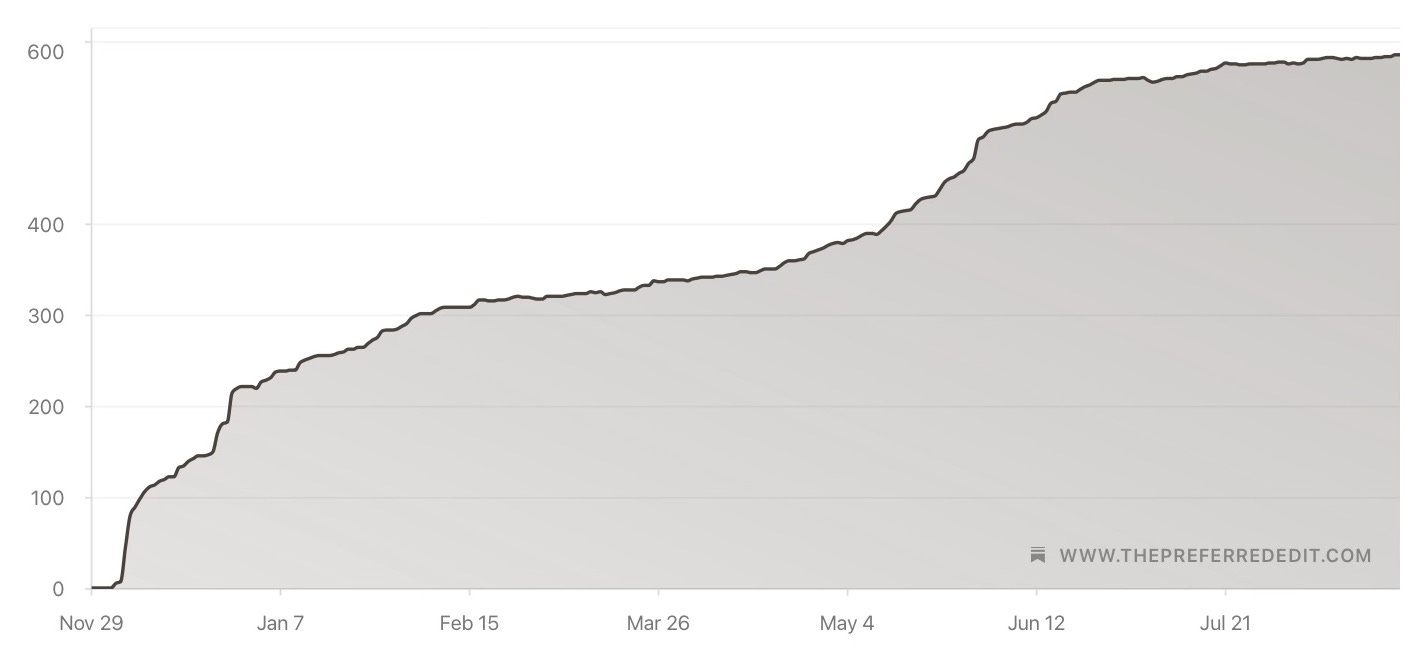
Getting comfortable with all of that is its own work. Because the triumph of a new subscriber hits just as hard as an unsubscribe hits later. Sometimes the unsubscribe lands with an even bigger punch to the gut, particularly if it’s someone I know personally.
As someone who didn’t arrive with a following of any kind, an email list I could upload from another platform, or relationships that would help catapult my growth, my trajectory is being built one article and note at a time. Trust me when I say, I celebrate each milestone along the way. I also completely cherish each subscriber. When a new one lands, there is a sense of validation of time, energy, authorship, and creativity that leaves me feeling proud and excited.
And while I love, in every sense of the word, the people in my life who read my work, I don’t expect it to land with everyone. Sometimes, I’ll be honest, it feels easier to have people I don’t know read my work than the people closest to me. Or the ones on the periphery.
I’ve read notes other people have published where they openly acknowledge having created an account and developed a Substack community without a single person in their world knowing anything about that. To those of you who’ve done that, I get you.
I usually don’t share my articles with anyone until they’re fully baked. I’m a perfectionist, after all.
But in this instance, I read this one to my husband, Dave, in draft form. He’s the one set of eyes, if not my daughter Elise, who gets a preview before I hit publish. They are my two trusted editors, and the stopgap before I send it off for the world to digest.
And when I read him this draft, he offered something interesting.
He said you’re not writing the old-world way, if we can call it that. Long before writing on social platforms became a thing, feedback came in one of two ways. From the professional critics who wrote about the work themselves, and from the sales that drove the numbers. On Substack, the feedback is immediate, and the critic is anyone and everyone.
And this new world requires one of two things. A thicker skin, and the ability to not get caught up in the statistics or the comments. Or complete anonymity, which is nearly impossible to come by, certainly with respect to writing personal essays. (If you’re among the other enviable type who has the uncanny ability to turn the other way, I applaud you.)
My husband said something else I also thought was interesting. When he reads an author, he doesn’t give up on them just because he didn’t love one thing they published. He used Grisham as an example. He’s loved so many of his books, even if a few of the early ones didn’t hit hard. But it never occurred to him to abandon Grisham as an author entirely. Back then, that idea barely existed. On Substack, it’s different.
If an article doesn’t resonate or the author doesn’t vibe, the option is simple. Unsubscribe. As the author yourself, that simple gesture can feel extremely personal, particularly when the content is just that, personal.
There is also another entanglement that comes with writing personal content, one that requires a different kind of finesse, and one that I think is worth sharing.
I’ve been on Substack for nine months now and have 69 articles published, a number that’s not lost on me. It’s my late husband’s angel number, and when it shows up, I am always reminded he is here for me. As it turns out, his passing and the grief that I’ve learned to live with are among many of the topics I have written about and will continue to share.
My life is my source material, after all. My experiences don’t exist in a vacuum. They exist in connection and relationship to other people. But I recognize the responsibility that comes with writing this type of nonfiction. There are other people to consider. People I love, people I respect, and people I want to protect.
And when I share an experience, I inevitably take into account how, where, and in what capacity the other people involved land on the page.
This is where I struggle, and I suspect it’s where others struggle too. It’s also why I developed these guideposts.
What it really boils down to is how much is too much and how little is too little. If my goal is to extract meaning from my experience, how much detail do I need to share? And if I withhold too much, have I stripped the story of the very thing that made it interesting or worth sharing? I also recognize that readers respond to real experience. It’s what makes stories relatable and shareable.
This is where the silent critic often takes a seat on my shoulder. And if I’m not careful, I start writing for that voice instead of for the person who might actually need to read what I have to say.
The private part of me gets to say, Wow, I can’t believe these things have fucking happened to me (or for me).
And then the writer part of me gets to ask, Wow, what did this teach me about being human?
Both of those voices are mine.
They just don’t need the same audience.
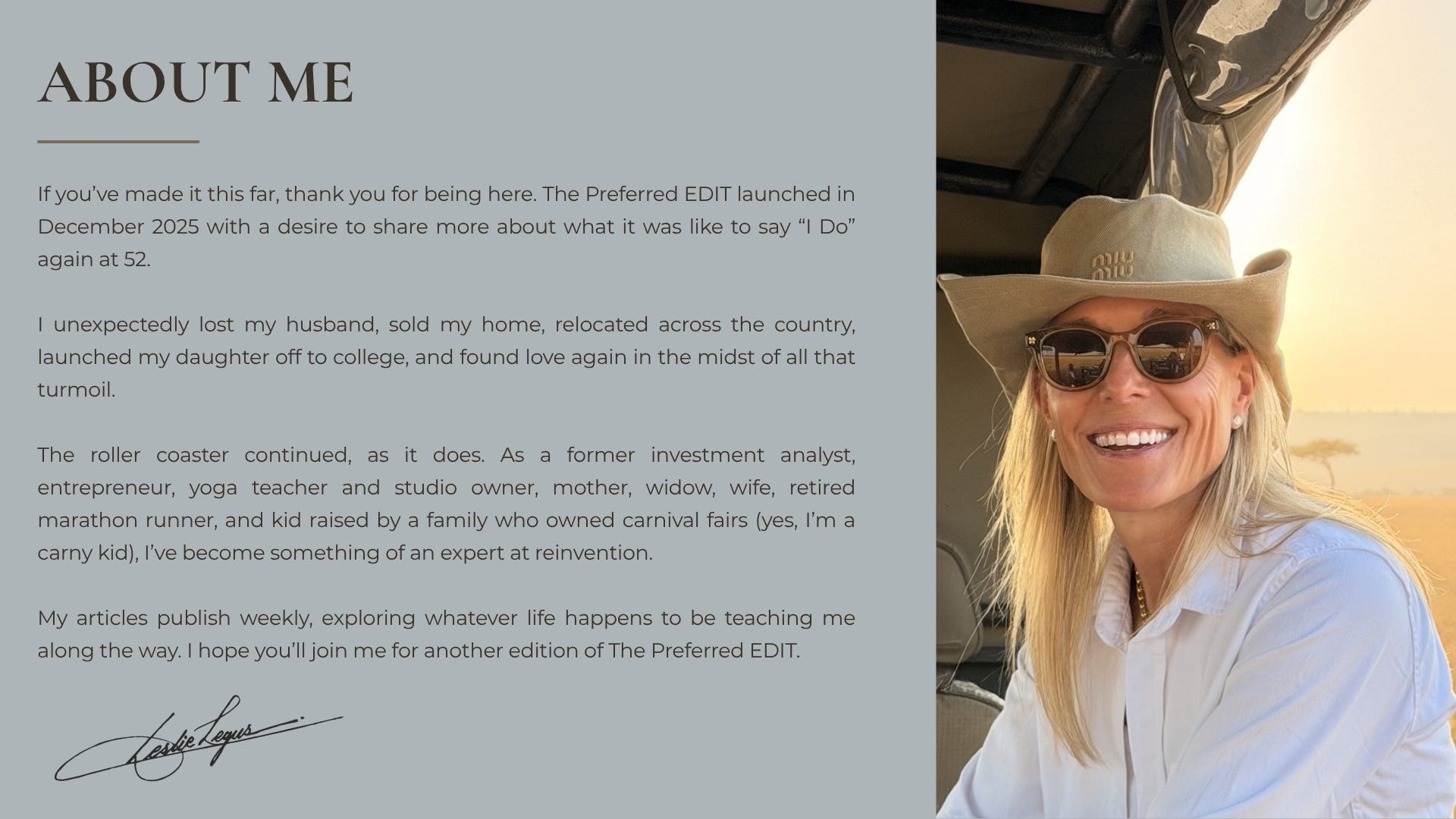
If you’re new here, welcome. I’m Leslie.
I’ve run ten marathons. I became a widow at 49, recently remarried the most remarkable human, travel every chance I get, and am deeply curious about health and longevity, relationships, ambition and how we choose to live. I also like the finer things in life and make no apologies for it.
I write from experience and about what matters to me in the moment. I’ll offer perspective from my non-linear life, along with questions and ideas that may make you pause or get excited. I’ll never gatekeep a new favorite find or a great idea. And I may even challenge you to get curious about your own life.
I want to be remembered as someone who helped others across the finish line, built community, offered guidance when it was needed and, perhaps most importantly, lowered everyone’s cortisol.
Join me. I’d love to have you.
Unless you’re writing technical content, this tightrope doesn’t exist. But I suspect a lot of people on this platform are coming in as nonfiction writers. Using their personal experiences as their muse, so to speak.
I think most personal essayists have experienced that feeling of am I oversharing, or did I share something I shouldn’t have. Or maybe just shared something they wish they hadn’t.
And that’s where I think the threat to writers begins.
When those voices become louder than our own thoughts.
When other people become the editor without ever entering the room.
When you’re writing around your experience in fear of that one critic in the corner.
As a personal essayist or creative nonfiction writer, your life is the source material. The experiences each of us endure leave a mark. They leave a fingerprint.
And maybe the editorial discipline is learning to write about the mark without necessarily revealing the fingerprint.
What it’s like to be destabilized in life, not who destabilized you.
To want to make shifts.
To learn to let go.
To be hurt.
To change your mind.
To realize something about yourself you couldn’t have known without living through the experience first.
The reader doesn’t need every detail. Quite frankly, some of those details would read like a TMZ article, and I can assure you I have no interest in writing that.
What I am interested in is what came out of it. That’s the heart of who I am. Curious. Always wanting to learn more about myself.
Because I lived the experience, and in some instances, I paid whatever price came with it. That holds true for all of us. Whether we paid a price or benefitted from it, there’s value in it. And perhaps not just for me. If I can take what I learned from it and turn it into something that makes another person feel understood, or maybe helps them see something happening in their own life a little differently, then perhaps that’s the part worth sharing.
For me, that’s where the best writing exists and what brings me back to the keyboard.
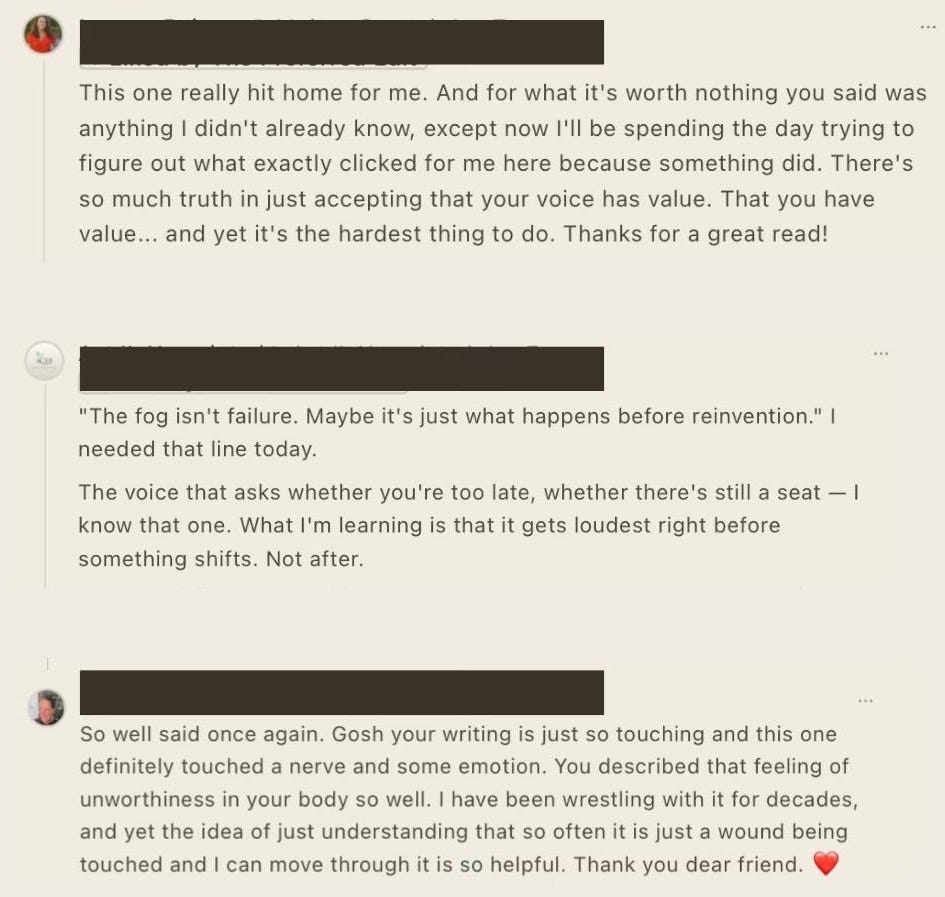
The discipline is what keeps me steady when the critic is anyone and everyone, and the exit is one simple click.
Rather than looking at the shadow on my shoulder as a critic, I’m using it as fuel instead. Fuel to get me across the tightrope with a little more grace, a little more elegance, and a whole lot more informed.
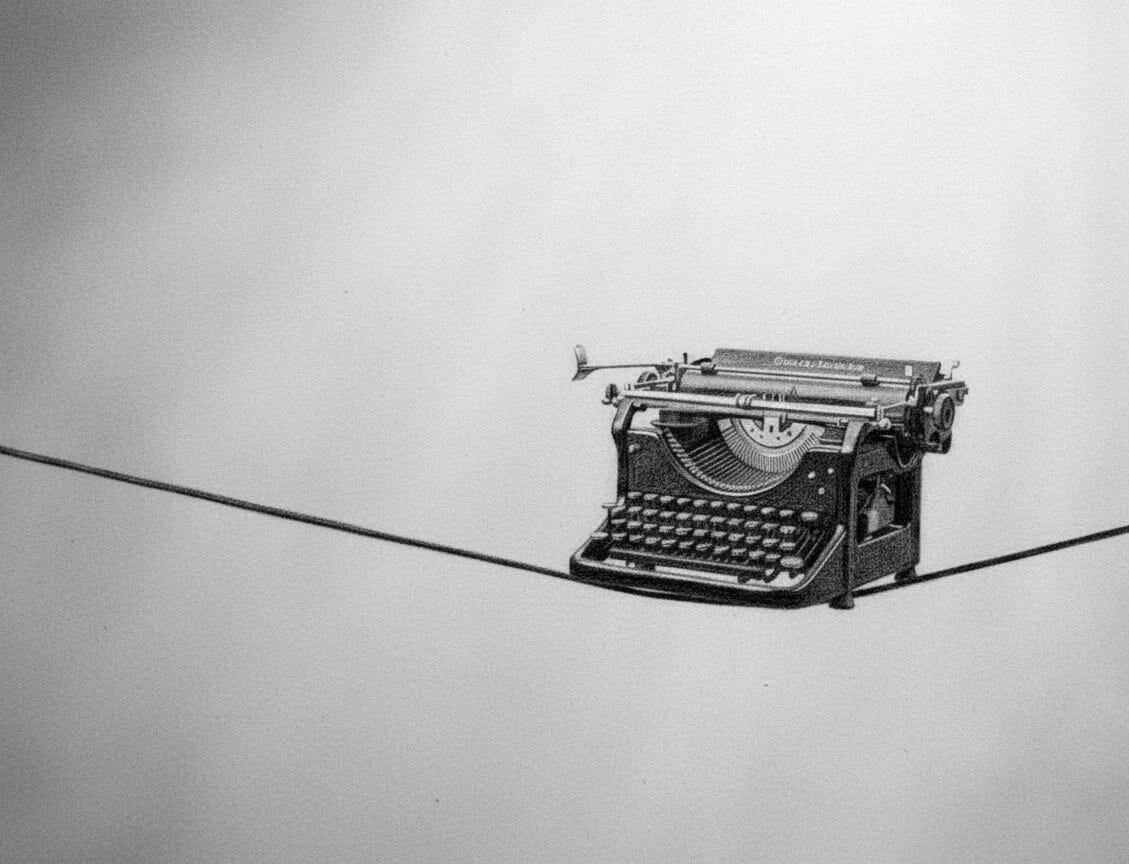
That’s the tightrope. I plan to keep walking it, and I plan to keep learning from it.
I didn’t arrive here having any true understanding of the craft of writing, and I have learned a tremendous amount along the way. I can’t profess to be an expert and am only now just owning the title of writer, essayist, author, all of which still feel awkward to own.
What I do know is that the critic isn’t going anywhere. Neither am I.
Writing from your own life experience doesn’t mean you need to air all your dirty laundry or anyone else’s for that matter. It’s about knowing where the line is.
If you’re writing personal essays, or considering it for yourself, here are a few guideposts I’ve learned to lean on over the last 69 articles that get me across that tightrope.
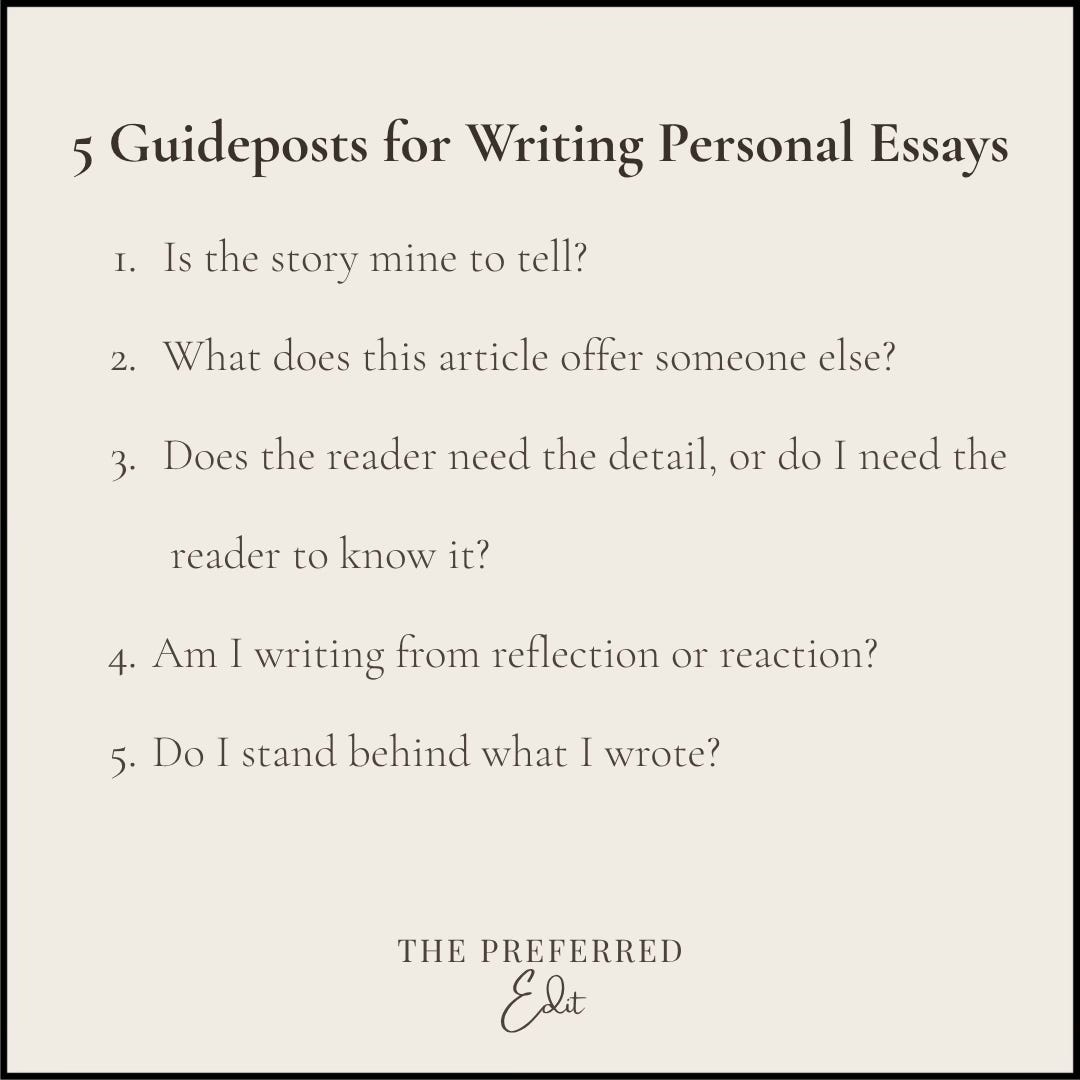
1. Is the story mine to tell?
I feel like this question is where that tightrope begins. Because if I’m writing about my life, there are obviously other people in it who shape my experiences.
The answer to this one isn’t always perfect. But I have learned that I can tell you what an experience did to me without telling you everything that happened. I can share details without sharing other people’s details. Maybe that’s the line. What did I feel? What did I learn? What changed because of it? Or more importantly, what part of me changed because of it? That’s the part of the story that belongs to me, and that’s where I have to write it from.
2. What does this article offer someone else?
I am not a niche author. My articles jump across all sorts of topics. What I publish usually comes down to what’s occurring in my world at any given time. But my intention is always to leave the reader with something.
There are plenty of articles to read on Substack, so I take seriously the question of what I can offer in exchange for someone’s time. Maybe it’s insight into something or someplace new. A reason to look at something in their own life a little differently. A new way of doing or trying something. Hell, sometimes it’s even a new pair of shoes I found and love.
Ultimately, I recognize and honor that people have a finite amount of time to read. What am I offering them in exchange for some of their most precious asset?
That question stays at the forefront of my mind as I hit the keys.
3. Does the reader need the detail, or do I need the reader to know it?
This one is hard to reckon with because, let’s be honest, details make a story better. They add texture, color, and sometimes that edge-of-the-seat feeling that puts you right there with the author. It’s the balance between exteriority and interiority, and the part of writing I am just learning about thanks to my incredible writing coach, Taylin John Simmonds. As I mentioned, I’m new to this craft and beyond grateful to those offering me both feedback and guidance.
But just because a detail makes the story better doesn’t mean it belongs in the story. That’s the part I’m learning.
Sometimes I have to ask why I want you to know it so badly. If it’s to prove I was right, or wronged, or justified, that’s not for the story, and I need to hit delete, which never feels easy.
I may still write the version where I get to say, You would not fucking believe what happened.
You just might never get to read it.
But if there’s something in the experience worth sharing, and a way to tell it without overexposing my world or someone else’s, you’ll probably find it in your inbox on one of my publishing days. I can assure you of that.
4. Am I writing from reflection or reaction?
While I have 69 published articles to date, there are countless others sitting in a folder behind the scenes that will likely remain unpublished for this very reason. If I look back at them now, I am sure today’s version of me is really glad they didn’t find their way out into the world.
There is nothing wrong with reactionary writing. That is what the unpublished folder and my journal are for. I believe in the power of putting pen to paper and letting it rip. It’s deeply therapeutic.
But reactionary publishing can become a forest fire of its own making.
This is where that extra set of eyes or editorial voice of reason becomes really important. Sometimes it’s necessary to let someone else vet the landing before a hard launch.
5. Do I stand behind what I wrote?
Sure, virality and likability are at the forefront of writing (for some anyway). But the real question is whether I can stand behind what I publish.
People are allowed to dislike what I write, and they are certainly allowed to interpret it differently than I intended. It’s almost inevitable. We all arrive with our own perspectives and no two will ever be the same. I can’t edit around every possible interpretation.
But I can ask myself whether I’ve written something I’m willing to stand behind.
And if the answer is yes, maybe that has to be enough. Because once it’s out there, it will always be out there. I don’t take that lightly before I hit publish.
Always EDITing,
Leslie
Join me for more.
I am here for all your comments. Don’t leave me hanging.
I was never going to get remarried

Getting married at 52 comes with a set of permissions I didn’t know I was allowed to give myself when I married at 26.

Thanks for your post. ✉️ You’ve inspired me to share what I wrote in my little digital journal yesterday about this very topic…
“It’s changing me.
The simple process of talking about the truth of my life each week publicly on Substack is having the net effect of inner growth.”
It is a balancing act and I am amazed at the strength it builds in character simply by going through the process, committing to being consistent and looking straight ahead no matter what anyone says or thinks.
My hats 🎩 off to you! Here’s to the future of writing and the wonderful places we’ll go from here! 💐
Having spent a fair few years online, sharing timelines of life, often intimately, I feel this juxtaposition a lot. As privacy maybe imposes falsely as dismissal to our experiences and in gorging on facts, there’s a risk of dragging ourselves back to previous pits of horror and expecting our readers to participate.
Your words on discipline encourage a maturity to the dialogue whilst granting ourselves a little grace to feel around for our true voice. My internal critic can be pushy but I always try to fall upon a thought of: ‘am I reading something which I would’ve needed at the time of experiencing it?’
I found this at a poignant moment, thank you.