

We left our wedding ceremony last December in a Moke. Not exactly a high-speed, state-of-the-art getaway car, but we live in a beach town, and it felt entirely appropriate.

Dave, my new husband, and I jumped into the back seat while two dear friends, Debi, who had just officiated our wedding, and her husband, Pierre, our unofficial chauffeur, took the front. It was hardly a traditional wedding getaway, but it was nothing short of fun, including the random photos we took en route to the reception.
Champagne glasses in hand, I immediately proclaimed into the open air, “I officially give up the title of widow!”
Without missing a beat, Dave shouted, “And I give up the title of bachelor!”
There we were, riding through town, raising our glasses and celebrating the end of two identities we were more than happy to leave behind.
We laughed, but neither of us was joking.
Dave was 58 when we married. He had never been married and had no children (I am very aware that I met an actual unicorn), and he was acutely aware of the assumptions that came with being a bachelor at his age.
He had shared with me that walking into meetings and boardrooms without a wedding ring often gave rise to his own insecurities as he imagined everyone making assumptions, as though the lack of a wedding ring was the most noticeable part of his arrival.
Was he divorced? Was there something wrong with him? Was he gay?
I feel the need to explain that none of those possibilities represented anything inherently wrong. Of course they don’t. But for Dave, he always had a desire to be married and therefore felt like the absence of a wedding band somehow required an explanation.
I understood.
Three years earlier, I had adopted the label widow, which seemed to change the way people looked at me and often led to awkward exchanges. I’ve found, myself included, that people don’t always know what to say. Death can be uncomfortable. I get it.
I became a widow at 49 when George, my husband of nearly two decades, died unexpectedly.
At first, there was comfort in owning the title. I think part of it made me feel closer to him in those early days of loss.
It also gave me exactly what Dave’s bachelorhood lacked. An explanation for being without a plus-one at a seemingly young age.
People inevitably and often subconsciously construct stories. It’s human nature. We want meaning, and in the absence of it, we create our own.
So I owned it.
It became part of my identity until something in me shifted.
Perhaps I grew tired of the pity. Or the need to explain what happened, which meant reliving it.
And while I initially wrote quite a bit about grief, I didn’t want to be identified as someone who wrote exclusively about it. Someone whose entire identity had become wrapped around the worst thing that had ever happened to her.
So I quietly removed widow from my bio, you know, that little Substack bio that’s supposed to turn visitors into subscribers.
And when I remarried, I was happy to announce that I was giving up the title altogether.
Or so I thought.
What We Choose to Leave Out
A few days ago, I found myself reading a Substack Note written by a woman who had recently lost her husband. She’s relatively new to the platform and was reintroducing herself.
As I welcomed Ana, author of Witnessing Kindness, I got lost in the comments. So many were written by other women who were also widows. And judging by their photographs, many of them, like me, were relatively young. Yes, I’m calling 52 young.
As I read their words, I felt an unexpected sense of connection.
I know their grief.
I know what it’s like when a tidal wave of sorrow arrives out of the clear blue sky while you’re standing in the grocery store. Suddenly, the spice aisle reminds you of how he would come home with more spices than anyone could possibly use in a lifetime.
I know how much courage it takes to bury a spouse and then begin living a life that looks nothing like the one you planned together. I also know how painful it is to come to terms with an expired future filled with shared dreams and adventures that will never be fulfilled as intended.
That beautiful young widow’s Note shone a light on the army of us out here. Not just young women, but women of every age, carrying losses that don’t simply disappear with time.
Somewhere in the middle of reading, I found myself reconsidering the word I’d so deliberately removed from my bio.
Widow.
I wanted it back.
And then I did something that makes me laugh a little now. I Googled whether I could still call myself a widow even though I’d remarried. As though I needed permission from the internet.
Of course I can.
I’m a wife. And I’m a widow.
Marrying Dave didn’t erase George or the nearly two decades we shared. Death doesn’t work that way. And moving forward and remarrying certainly don’t erase grief either.
I miss George every day. Grief still comes in waves, often when I least expect it.
And God love my husband, Dave, who has made room for all of that, including George’s continuing presence in our lives.
Looking back, I didn’t remove widow from my bio because it was no longer true.
I removed it because I felt like it landed like a bomb, with an explosion of connotations I no longer wanted to be associated with.
And ironically, here I am, wrestling with how I want to be known.
How Do You Want to Be Known?
When I arrived on Substack nearly a year ago, I hired a writing coach. (Taylin John Simmonds, and he’s amazing.)
Of course I did.
It’s completely in character for me. I’m a Type A perfectionist who loves to learn (and who is also trying to roll more like a ball and less like a square). I’m also here to build something, and I want to get this “right,” but in a way that feels right for me.
Hiring a writing coach has been one of the greatest gifts I’ve given myself. Despite decades of professional writing, I never considered myself a writer, let alone an essayist. And I certainly didn’t know, and still don’t, how to write a captivating title. That is an art form I genuinely envy in others.
But I’m learning.
And that’s the point.
Last week, my homework was to consider one question.
What do you want to be known for?
He threw the question out at me and then proceeded to pull up my Substack bio. I think I actually shrank a little in my chair.
If you’re a writer on Substack, you’re familiar with that little box where you’re supposed to introduce yourself, explain what readers can expect, and give them a reason to subscribe. All in fewer than 25 words. I assume that’s the goal, anyway.
For readers, it can be a make-or-break moment. In less than five seconds, they’ve either double-tapped or moved on. Sorry, that’s the harsh reality of being on a platform with countless others.
It’s like writing article titles or making small talk at a cocktail party. I suck at both. And now my bio was under scrutiny by someone I revere as a talented, knowledgeable writer and coach.
Unbeknownst to Taylin, I’d been playing around with mine for a while. By the time he pulled it up, I couldn’t even remember which version he was looking at because I kept changing it.
The point of the conversation, and the homework that followed, wasn’t to perfect my bio. Is there actually a perfect one out there?
Taylin wanted me to think beyond those 25 words.
What did I want to be known for? Not what I’d accomplished or the subjects I enjoyed writing about, but the one or two words that could become the lens through which I approached my writing.
Sounds simple enough.
Until you’re the one trying to answer it.
I found myself completely frustrated, disappearing down countless rabbit holes exploring what other writers had created for themselves.
And then there’s my personal issue with sameness.
It’s a deeply rooted childhood issue, probably stemming from being dressed to match. Case in point.
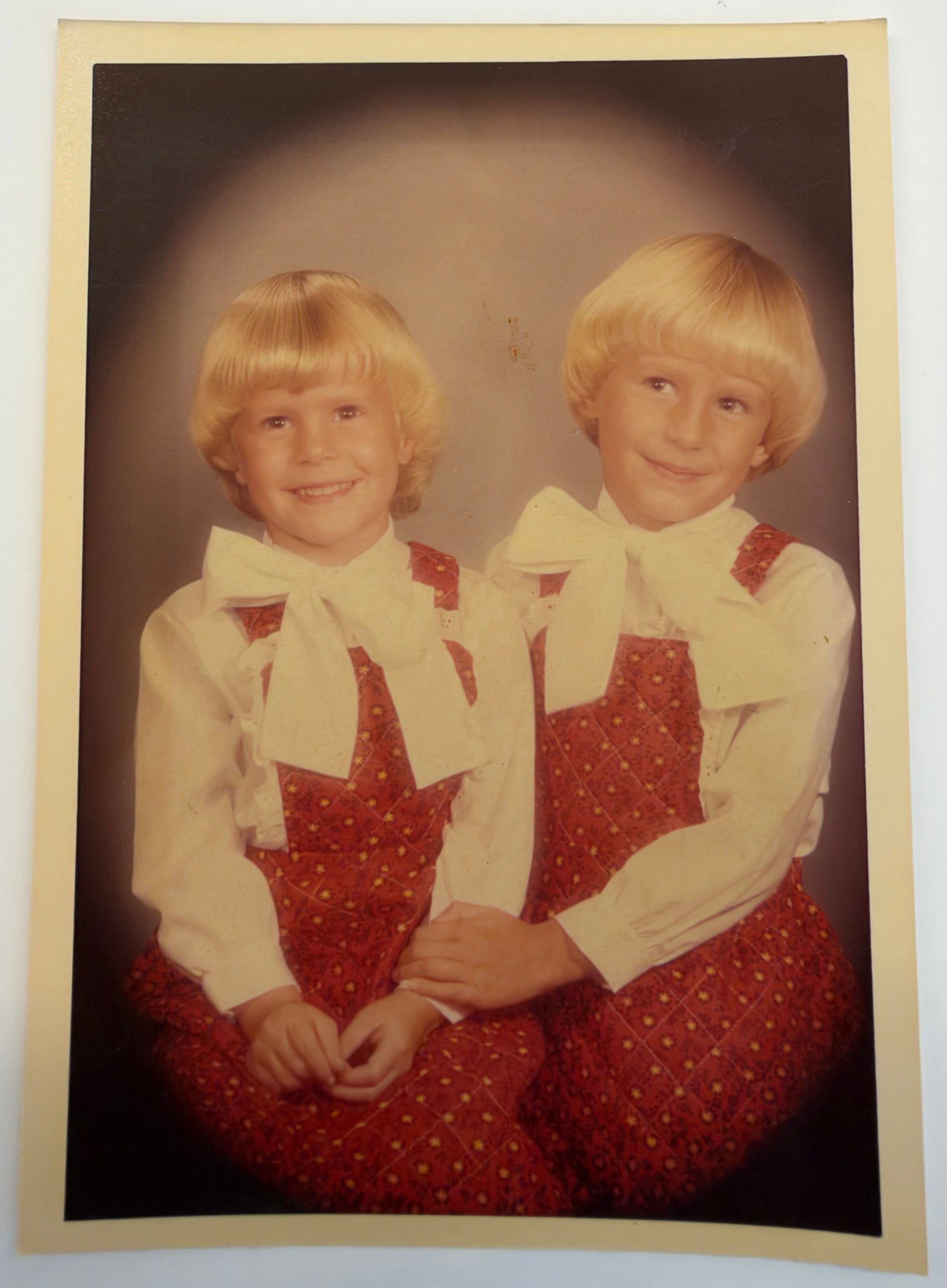
And one I clearly need to address with my mother, who apparently thought this was a good look.
There’s a lot of sameness out there, and I’m admittedly a little allergic to it. Much like I was to polyester as a child.
I don’t mean that to be dismissive of anyone else’s work, and I’m certainly not suggesting there’s anything revolutionary about my own bio. But spend enough time reading Substack bios, and you’ll start noticing the similarities.
Authentic. Provocative. Insightful. Willing to say the things nobody else will.
How many different ways can we describe ourselves using essentially the same words and still manage to sound unique?
It’s surprisingly fucking hard.
And I think that’s partly why, in one fell swoop, I deleted Mom and Reinvention, along with a host of other words I can’t even recall. I had already removed Widow for all the reasons I shared earlier.
At one point, I even found myself getting a little pissed off at my writing coach. (Sorry, Taylin. It’s a me problem, not a you problem.)
But the more I thought about it, the more I understood why he was pushing me to get so specific.
It’s relatively easy to come up with a few adjectives that describe how we want to be perceived or how other people perceive us. Just a few weeks ago, I was in a session where a group of people had to share in one or two words how they experienced me. What an amazing and introspective gift that was. If I could simply use those words, my homework would be done.
But that wasn’t what he was asking.
It’s one thing to acknowledge how other people perceive you. It’s another thing entirely to identify one or two words that represent the perspective we consistently bring to our own writing.
Think about James Clear, Stephen Covey, Brené Brown, and Mel Robbins. Each of them has a lane that’s completely dialed in. Can you bring to mind Brené Brown without immediately thinking of vulnerability and shame? Or Stephen Covey without jumping straight to habits?
When I thought about it from that perspective, the question clicked and I pulled myself out of the rabbit hole.
It’s not about telling people what you want to be known for or other people telling you how they perceive you.
It comes down to this. What is the one word (or two) that comes to mind when other people read your work?
When you think about this, consider that the question is bigger than any one article. It’s about using that word or words as a guidepost or lens through which you approach everything you write.
The work is to understand what makes your writing distinctly yours, and then deliver on it consistently.
I went back and replayed the conversation with Taylin more than once. As frustrating as the exercise initially felt, it gave me considerably more clarity about what I’m building here. And that’s what gets me super excited.
I imagine I’m not alone here. I suspect there are others out there considering how to take their publications to the next level, whether they’re writing on Substack or somewhere else.
How Do You Answer the Question?
Like anyone, I wanted the quick fix. The easy answer. A shortcut to figuring this out.
Unfortunately, that’s not what’s available here. Sorry to say it.
What finally helped was sitting down with my husband, Dave, and talking it through. I wasn’t asking him how he sees me. I was thinking out loud until I could hear the answer myself.
Think about Brené Brown, for example. She writes about leadership, parenting, work and relationships, but she’s always looking at them through vulnerability.
You don’t need a niche. You need a lens.
That’s exactly what Taylin was asking. And that’s what my conversation with Dave allowed me to get really clear on.
We often joke that he’s my editor-in-chief. Neither of us is joking.
But what I can tell you is this.
Somewhere between Taylin’s original question and reading Ana’s Note on Substack over the weekend, I found myself putting widow back into my bio.
Because it is a lens through which I see the world. Losing George unexpectedly, and everything that followed, changed my perspective in ways I couldn’t have imagined.
Somewhere along the way, I began to take inventory of my life and my choices differently. Unexpected loss or, any kind of loss, will do that. What matters and what doesn’t suddenly become obvious. It’s like shifting from black and white to HD overnight.
Navigating those early and darkest days required a level of strength, grit, stamina, and resilience I didn’t know I possessed.
I didn’t choose to be a widow. But I earned that title, and I am going to wear it proudly. I see it now not as something to be pitied for, but rather as a badge of honor representing everything that was required of me when it was bestowed upon me.
While I don’t want to be known for grief or reinvention, I’m getting clear on what I do want to be known for. And that’s where I intend to write from.
There’s a level of discernment involved in answering this question, and I think that’s true for anyone willing to give it some serious thought.
I’ve also realized that I don’t need my bio to explain every subject I might explore. If there’s one thing I know about my life, it’s that it isn’t stagnant. And I certainly don’t expect my writing to fit neatly into one little box.
So whether you’re writing a Substack bio, updating your LinkedIn profile, or delivering your dreaded “elevator speech” when someone asks what you do for a living, I think Taylin’s question is worth borrowing.
What do you want to be known for?
Not what sounds impressive, clever, or funny. Maybe those things are simply inherent in what you end up saying.
But what do you want people to consistently recognize in the work you put into the world?
Or perhaps an even better question for my fellow writers:
If someone read ten things you’d written without seeing your name or bio, what would make them recognize you?
I finally have my answer. I’m going to live with it a little longer before I share it here.
Now I get to do the work.
Always EDITing,
Leslie
Leave me a comment or drop your bio. I’d love to read it. I am still working on perfecting my bio, and I need all the inspiration I can get.
P.S. Taylin, you should have known that giving me an assignment like this would result in an entire article about it.
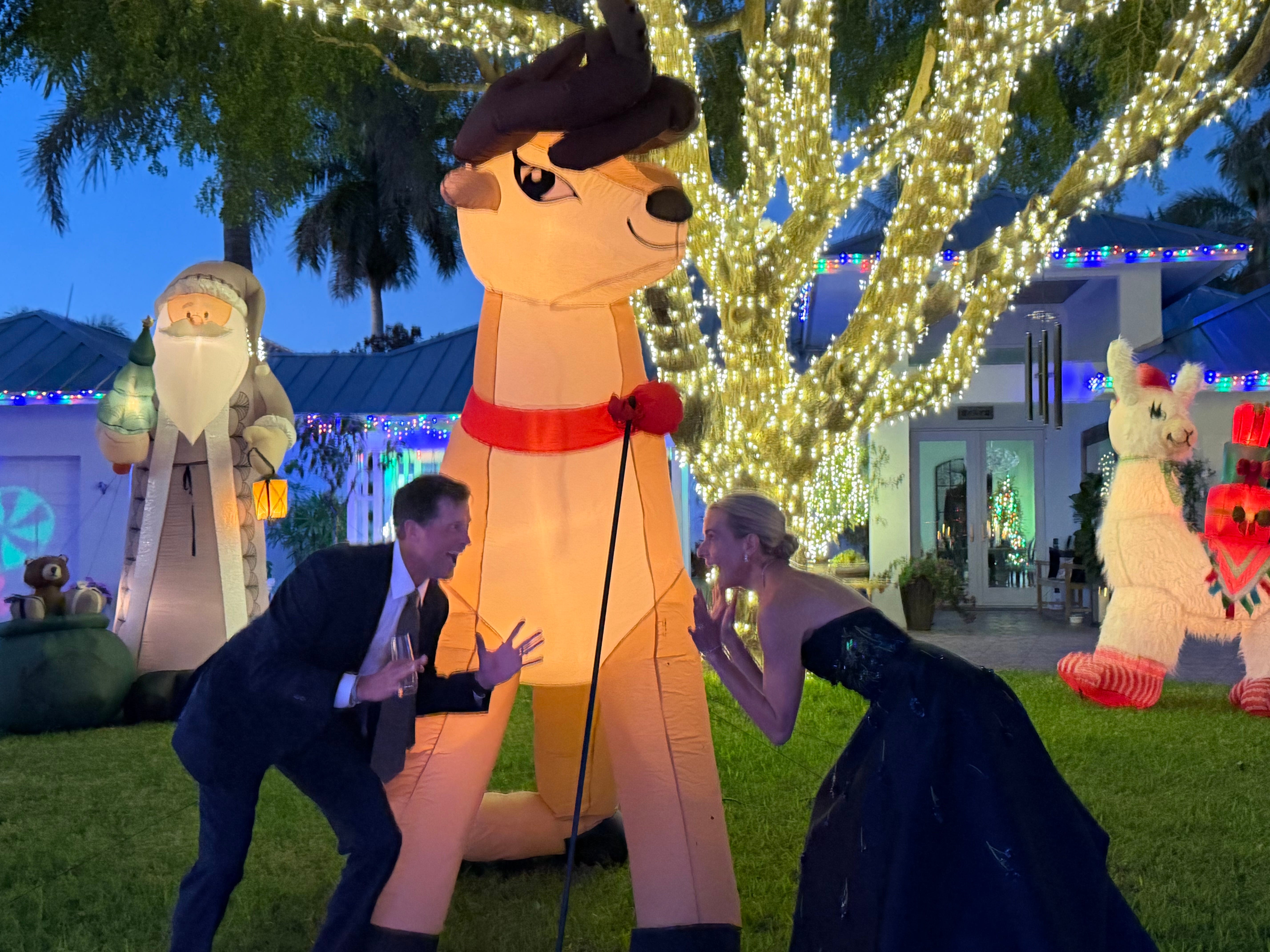
P.P.S. Remember the random photos from our Moke ride? This is one of them. We literally jumped out to pose with a stranger’s inflatable reindeer. The homeowner came out and said they’d never had anyone stop for a photo in formal attire. It felt too perfect not to happen in the moment.
MORE OF MY RECENT WORK
The Art of Being the Most Grounded Person in the Room

Last Friday evening, I walked into a room filled with 40 people I had never met before.
How to Write a Personal Essay Without Overexposing Your World

As an essayist, the hardest moment is when I hit publish. I wish I were the kind of person who could walk away from my computer without wondering how what I wrote will land. Will someone like it enough to subscribe? Will someone else dislike it enough to leave? Both happen, time and time again.
I loved your story…and these wonderful photos? How could you ever have doubted your ability to be fun!
Thank you for your introspection becoming inspiration for my own. Love reading your writing. 🩷