


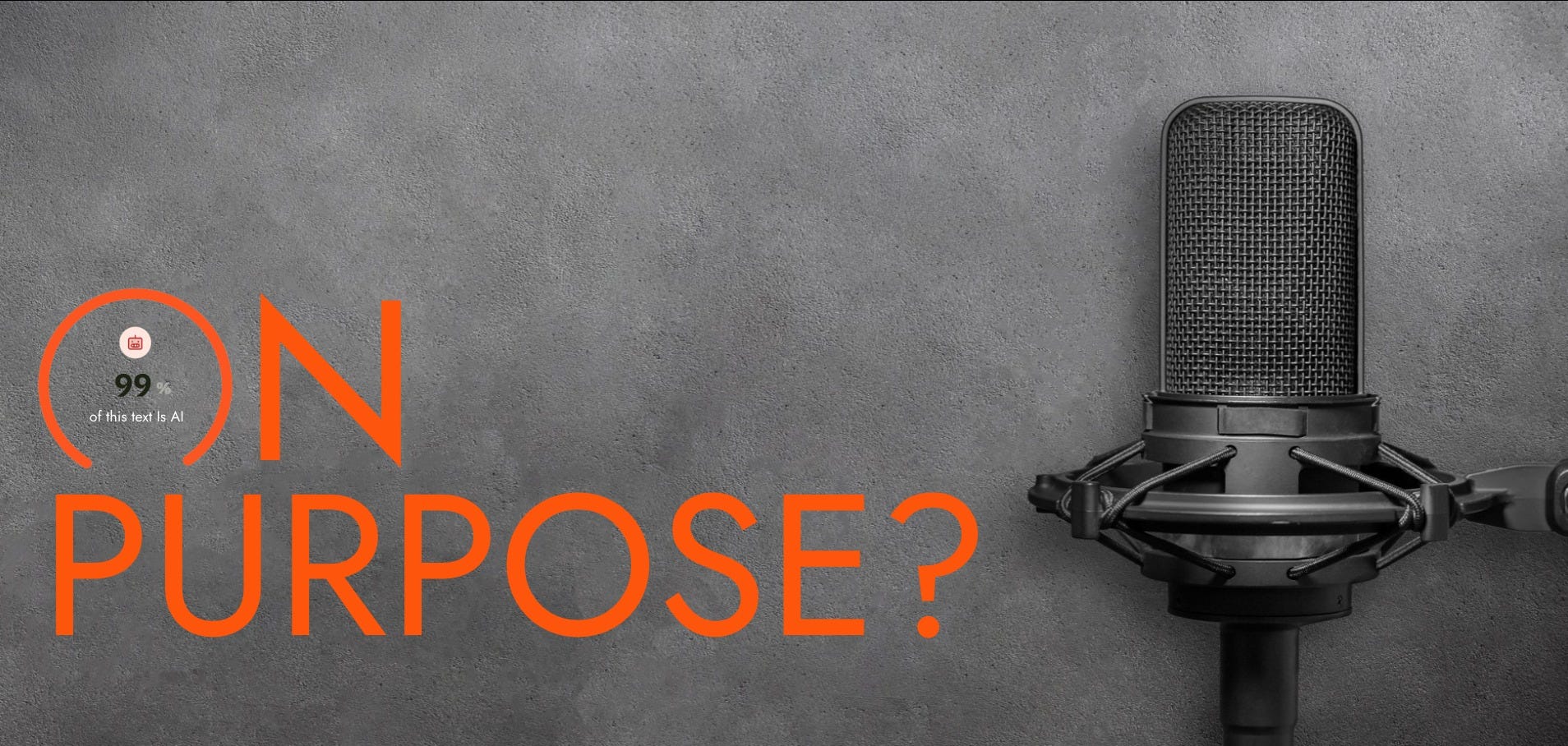
I was driving in my car the other day, repeatedly hitting the 15-second rewind button on my Apple CarPlay screen.
I was listening to Jay Shetty’s podcast, On Purpose, and I couldn’t keep up.
It wasn’t because I didn’t understand what he was saying. Quite the opposite. He was sharing some really thoughtful ideas, one after another, and I wanted to absorb them.
But before I’d had a chance to consider one thought, he was already three thoughts ahead of me.
Rewind. Listen. Rewind again.
I was getting intellectual whiplash.
The episode was called 5 Habits to Think Clearly When You Feel Overwhelmed.
Here’s the irony.
He was talking about how we consume so much information that we rarely stop to think about what we’ve learned, much less put any of it into practice.
At one point, he even described someone listening to a podcast while driving.
Hello. That was me.
Sitting in my car. Listening to a podcast about how to absorb information while desperately trying to absorb the information being shared.
I remember wondering whether driving was the problem. Perhaps I was too distracted by traffic to give the podcast the attention it deserved.
But I couldn’t shake the feeling that something else was missing.
There was no space for the words to land. No pause to let an idea settle in my brain, much less my body. It was one universal truth after another, delivered at a pace that left me feeling strangely disconnected.
I finally thought I’d be better off going home and reading the transcript.
At least then I could pause whenever I wanted.
And I pretty much forgot about it.
Until Instagram intervened.
Three little dots
A few days later, I was scrolling through Instagram when a video appeared in my feed featuring a female news broadcaster teaching people how to speak effectively using a teleprompter.
Why Instagram decided I needed teleprompter lessons is anyone’s guess.
This woman was explaining the importance of pacing when reading from a teleprompter.
One of her techniques was inserting three little dots into her script to remind herself to pause.
Three dots. Such a simple technique.
There was something about the way she said it that made me think about that moment in the car when I was listening to Jay Shetty’s podcast.
Was he also reading from a teleprompter?
Don’t get me wrong. I don’t think there’s anything wrong with using a teleprompter. Plenty of creators use them. Public speaking, whether on a stage or in front of a camera, isn’t easy. I know that from personal experience.
But perhaps part of the reason for the disconnect I was feeling was because the use of a teleprompter?
I shared my frustration with a friend, and she immediately understood. In fact, she said she couldn’t listen to his solo episodes for the very same reason.
Neither of us felt any sense of embodiment in his words.
Interestingly enough, though, we both really enjoy his podcasts when he brings on a guest.
There’s a natural back-and-forth, a sense of curiosity and engagement. I almost feel like I’m sitting at the dinner table with them, listening in on a fascinating conversation.
His solo episodes are different. I feel like he’s talking at me rather than to me. One universal truth after another, with barely enough time to absorb one before he’s moved on to the next.
Again, it’s that intellectual whiplash. I find myself wanting to do that thing my 21-year-old daughter does to me mid-lecture, where she repeatedly taps her fingers against her thumb, signaling for me to zip it.
I get it now.
I want to scream, “Please, pause! I want to absorb your wisdom!”
But off he goes, delivering more, while my brain is left spinning.
After the latest tailspin, I found myself wondering whether it was really just his delivery and my desire for him to slow down, or whether he was somehow disconnected from the words themselves.
He does sound a little robotic, after all.
Down the rabbit hole
I did what any naturally curious woman who probably should have been a CIA agent would do.
I found the transcript of the podcast I’d been listening to and dropped it into Pangram.
What is Pangram? Ask any writer on Substack, and you’ll get a mixed bag of reviews. It’s been a hot topic since Substack introduced the AI detection tool in July 2026.
Pangram, whose icon is fittingly a fox, is considered one of the most accurate AI detectors out there.
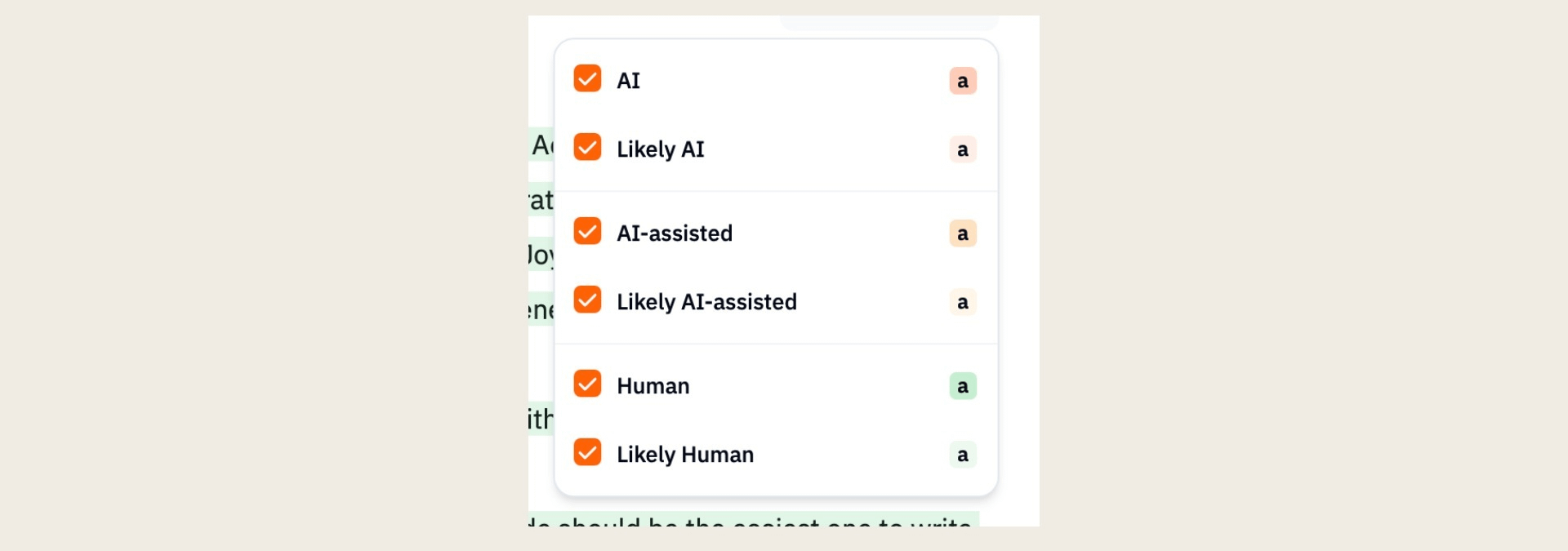
It works like a meter, scoring writing anywhere from 100% human to 100% AI-generated. It then highlights each passage in one of six ways: AI, likely AI, AI-assisted, likely AI-assisted, human, and likely human. It’s that dialed in.
There is no outsmarting this fox.
According to Pangram, it’s “designed to detect AI-generated content with a near-zero false positive rate,” with a claimed error rate of 1 in 10,000. That’s the part writers love to debate.
In a world where I am no longer certain if I’m speaking to a human on the other end of the line when calling for a service technician because my cable went out, I welcome the transparency.
But others share concerns about false positives and the possibility of having genuinely human work mislabeled by what is ultimately a machine. Some writers have chosen to turn off the detector for fear that using it feeds the algorithm more content and makes AI writing even stronger. All are valid concerns.
My take on it is fairly simple. If I’m going to spend my time reading someone’s work, I want to know that someone actually wrote it. I’m in the camp that checks the AI detector before choosing to read an article.
I want to support humans. I don’t think that’s so wrong.
If someone has their detector turned off, an option Substack provides, I have a tendency not to linger too long on that article. It’s a choice, and one I appreciate having.
And yes, I use AI. I find it enormously helpful in my own life. It’s currently building me a travel itinerary, which is saving me immense time. So I certainly understand the value of it.
But writing feels different to me. Technology can certainly help to express and expand on thoughts, but using it to author them entirely isn’t something I want to lean into anywhere.
So, I uploaded the transcript for the podcast episode I was trying to digest.
Pangram’s result?
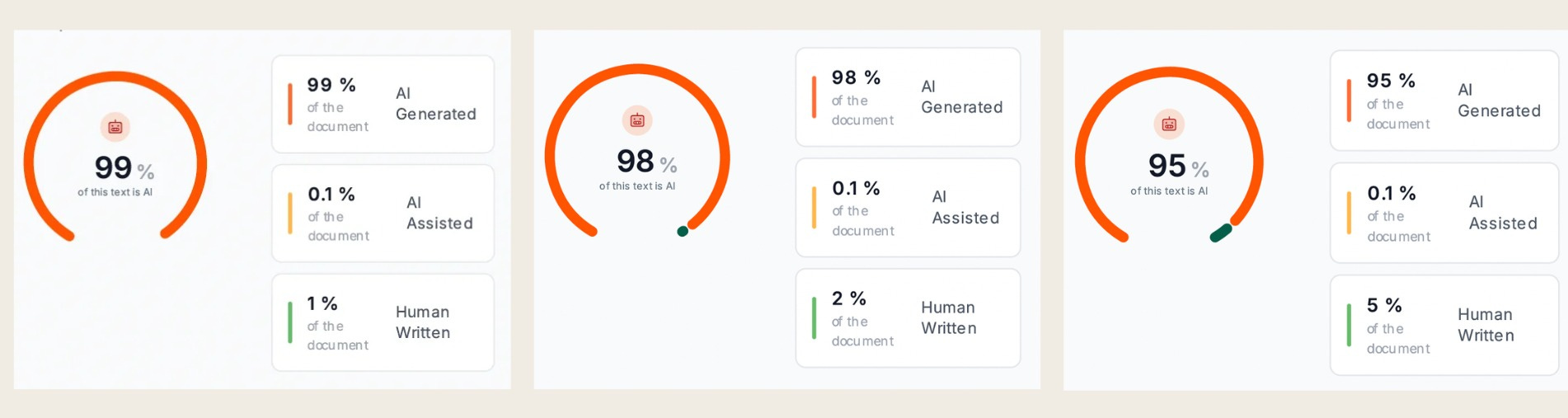
99% AI-generated.
I think my jaw hit the kitchen countertop.
Given Pangram’s claimed level of accuracy, I found the result disturbing.
Here’s a podcast guru I revere and love. Had I stumbled upon the transcript of this solo episode as a Substack article and seen those Pangram results, I wouldn’t have spent the time reading it.
That realization bothered me almost as much as the result itself.
So I ran a few more of his solo episodes through Pangram, How to Change Your Life in 90 Days (And Make It Last) and How to Set Boundaries With Family Without Feeling Guilty.
Maybe it was wrong? Maybe I’d found the 1 in 10,000 error.
And to be fair, I removed the advertisements from the transcripts because I wanted to examine the podcast content itself. I wasn’t interested in testing the words of a sponsor or an advertisement.
The results?
98% AI-generated and 95% AI-generated.
Three solo episodes. More than 14,500 words, and nearly all of it flagged as AI-generated.
Not only was I baffled, I was, and still am, admittedly a little pissed off.
I’m also completely unsure what to make of it. Am I the only one who’s noticed? I consulted with Dr. Google, who suggested Jay Shetty’s podcast is not AI-generated. Yet here I sit with the results.
For all of these reasons, I feel it’s important to clarify that these are Pangram’s assessments. I have no verified findings whatsoever about how Jay Shetty or his production team creates his scripts. I have no idea who actually produced the material or how AI might have been used in the process.
But to be honest, as much as I hate knowing this about someone’s words I truly value, it’s a bit like realizing Santa Claus isn’t real.
Sorry if I ruined that for anyone on the brink of Christmas.
But yes, that’s how deflated I feel.
Three solo episodes with the same results suggest enough consistency for me to question something I’d always assumed was true.
The $100 million question
Let me be clear about something.
I like Jay Shetty.
I really do.
I don’t listen to a tremendous number of podcasts, but his is one I return to. He’s extraordinarily polished, articulate, charismatic, and has a distinctive voice.
He has an incredible lineup of fascinating people he’s interviewed. I love listening to those conversations, and I’ll continue to tune in to those episodes.
And let’s not overlook what Jay Shetty has accomplished. It’s remarkable by any measure.
I went to his website and started looking at the numbers. More than 70 million followers across his social platforms. Over 10 billion views and 43 billion media impressions.
I can’t even wrap my head around those numbers.
He’s a bestselling author, an award-winning podcaster, and a former monk. No wonder so few people question his content. Who’s going to argue with a monk? Ancient wisdom is his practice. Nothing about the word ancient suggests AI.
Never mind that his eyes are captivating, and, in my book, he’s attractive. So yes, I get the numbers.
All of that adds up. In 2026, he struck a multiyear deal for his podcast reportedly worth up to $100 million.
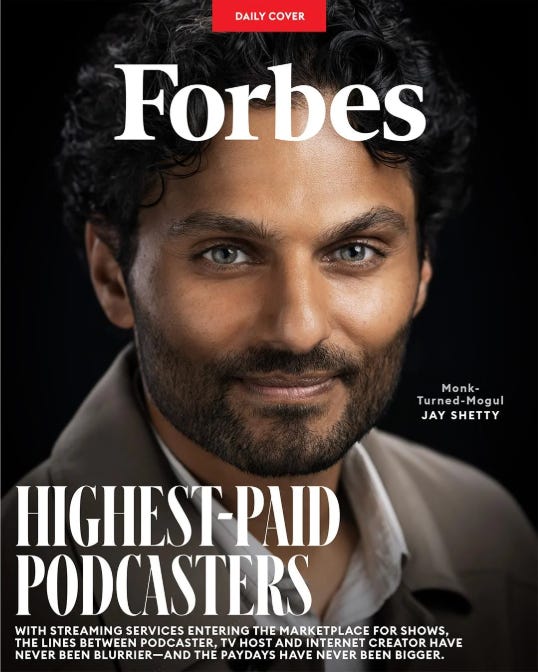
Maybe that’s part of my rub. It’s a hell of a lot of money for content that’s not landing authentically for me.
And maybe that doesn’t matter. Maybe it just matters to me.
He’s certainly gifted and exceptionally talented. His podcast is called On Purpose. It’s about living a meaningful life. My assumption was that it delivered on that with authenticity. Again, he trained as a monk. Isn’t that inherent in the practice?
Maybe that’s the foolish and naive part of me. Assuming that authenticity is part of the package.
Here’s what bothers me. I’m a writer on Substack, proving my humanness with every article thanks to Pangram. While I can turn off that function, I don’t want to. I want my readers to know there’s a human sitting behind the screen.
And I’m not the only one. AI writing has become a source of contention well beyond the confines of Substack.
There are writers who’ve lost book deals over allegations of AI use. AI was a major issue in the 2023 Writers Guild of America strike. And there are writers who are frustrated because something they spent hours writing is being flagged by a machine.
I understand the frustration. I also understand why readers want to know.
But why are we holding writers to one standard and seemingly not asking the same questions of people who speak for a living?
If I wouldn’t spend ten minutes reading a Substack article that Pangram classified as 99% AI-generated, why am I spending 30 minutes listening to someone deliver it?
And why hadn’t I thought to question it before?
Maybe I’m looking for something different
One of my favorite podcasts is The Wellness Process with Elizabeth Endres Orrigo.
Her solo episodes are among my favorites. She’s considerably younger than me. I’m probably older than her mother. But she’s raw, real, relatable, and sometimes she’s figuring things out as she goes. She offers insight and a perspective that gives me pause. I feel like I’m sitting with a friend at dinner, and I love that about her.
Not everything is relatable. Like I said, I could be her mom’s best friend, not hers. But I don’t feel like I need to hit the rewind button when I listen to her.
So, have I been duped?
I don’t know. All I know is that three episodes from one of my favorite podcasters have left me questioning something I wasn’t ready to question.
Again, kind of like when my older sister pulled the Band-Aid off the Santa Claus charade.
Like Santa, I haven’t stopped liking him.
But I now question something I’d previously taken for granted, and not just with Jay Shetty or the cable service department.
Maybe it’s the naïve version of me. The gullible Midwestern girl with an empathetic heart and wide eyes for the world.
Or maybe it’s On Purpose?
But now I’m going to wonder, what’s real? Whose wisdom is borrowed from a bot? And what am I willing to accept as a new norm if that’s in fact the case?
When I’m looking for wisdom, I don’t need every sentence to be profound. Maybe I just need space for it to land.
Maybe three little dots would have helped.
...
Always EDITing,
Leslie
Have you ever questioned whose words your really listening to? I’d love to hear from you.
P.S. If I ever had an aspirations to be a guest on Jay Shetty’s podcast, I think I may have just lost my opportunity. But I would welcome his comments here.
ABOUT ME
MORE OF MY WORK
How to Write a Personal Essay Without Overexposing Your World

As an essayist, the hardest moment is when I hit publish. I wish I were the kind of person who could walk away from my computer without wondering how what I wrote will land. Will someone like it enough to subscribe? Will someone else dislike it enough to leave? Both happen, time and time again.
How to Stop Taking Everything So Seriously and Reclaim Your Playful Spirit

Somewhere between being the pot-smoking, rule-breaking teenager who snuck out the back door and rolled the car down the driveway after midnight (sorry, Dad, but that truth was bound to come out eventually) and turning 52, I stopped being fun.
I don’t love it when people look for all the negatives around a creator, BUT I do think it might be useful to read The Guardian’s article on him. I couldn’t remember where I read it so I used ai to find it😉Uncovering the higher truth of Jay Shetty,” written by John McDermott and published in The Guardian on February 29, 2024. It investigates Shetty’s account of his time as a monk, allegations that he shared others’ work without credit, and what students get from his life-coaching school. I just remember it being really eye opening. There is something that happens when someone blows up. He becomes a product, and that becomes a machine, and reading this from you made me wonder if you might even be hearing a synthetic voice? I’ve made a synthetic version of my singing voice. I sound incredible 😜…but the flaws and cracks and pauses are why people pay to hear me at a concert. I use ai too, and think it really has its place. I go back and forth with how much to use it in my work. As the creator, I think it’s my right to do it however I please. The result as to whether or not it’s good inevitably is figured out in the marketplace. Another thought: I love Martha Beck. But then I helped one of my old voice students with designing her website when she became a life coach through her program, and she would always say the phrase in her own coaching “Tell me where I’m wrong.” It grated so hard on me. It was so obvious Martha’s coaching program gave them phrases. Again, not wrong and up to the producer or life coach…but it made me not want to work with this particular life coach. It gave me the ick. I still read Martha’s books however, because they seem to come directly from her. For now anyhow. It’s a tricky world we live in. I could say this all about Mel Robbin’s, whose podcast I really like…but she’s got a whole slew of controversy there as well. But life is nuanced. Great article! Thank you for the insight.❤️❤️❤️
I laughed at the image of you repeatedly hitting rewind while driving through an episode about how we consume too much information. And your daughter's finger-tapping signal for you to zip it made me laugh even harder. There's a genuine frustration underneath the humour, though. I also appreciate that you distinguish Pangram's results from any verified claim about who actually wrote those scripts.